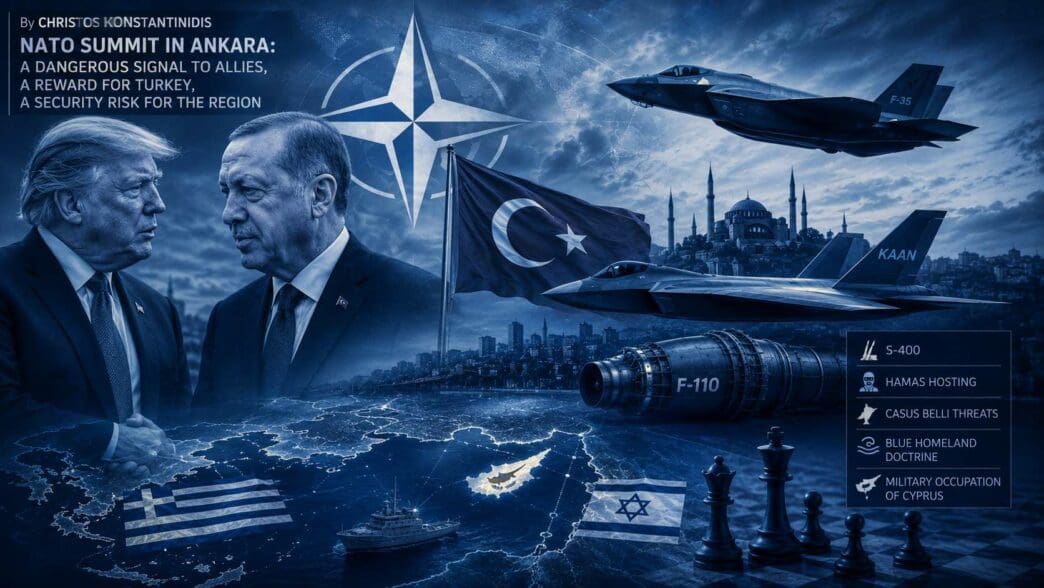
By Christos Konstantinidis
The NATO Summit in Ankara was not merely another diplomatic stage for photographs, statements, and routine assurances about allied unity. It was a political message. And that message was troubling for those who see Turkey not as a force for stability, but as a power that threatens allies of the United States.
With his public remarks alongside Recep Tayyip Erdoğan, Donald Trump left open the possibility of offering Ankara what it has sought for years: a return to the F-35 program, a reset of military trust with Washington, and access to critical American defense technology. At the same time, the issue of F-110 engines for Turkey’s KAAN fighter jet is also on the agenda — a program Ankara presents as a symbol of independent defense power, although in reality it still needs Western technology to become operationally viable.
Trump did not announce a final decision. He did not have to. In politics, the signal is often enough. And the signal Ankara received was that Washington is willing to reopen discussions on issues that should have been settled in 2019, when Turkey was expelled from the F-35 program because of its Russian S-400s.
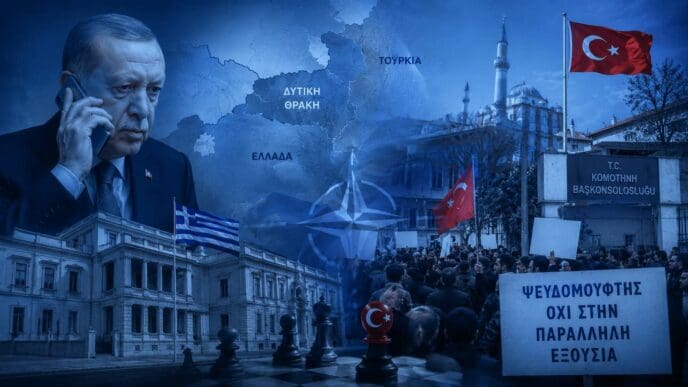
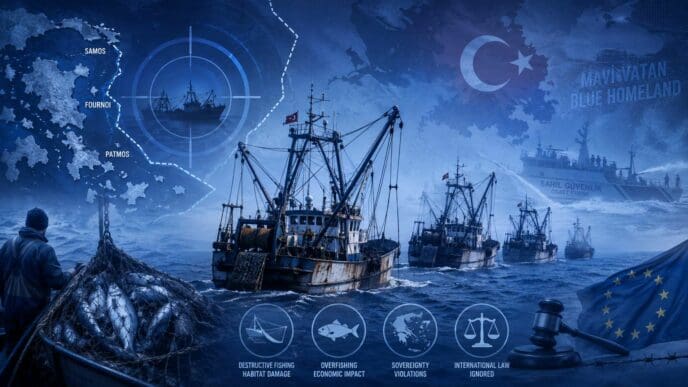
The contradiction is glaring. Turkey still retains the Russian air defense system. It has not abandoned its ties with Moscow. It does not fully align with Western sanctions policy against Russia. It hosts Hamas figures. It attacks Israel politically with language that goes beyond the limits of diplomatic confrontation. It threatens Greece with casus belli. It militarily occupies the northern part of Cyprus. It promotes the “Blue Homeland” doctrine as a tool for challenging Greek sovereign rights.
And yet Washington continues to roll out the red carpet.
Even the ceremony of the Ankara Summit carried its own symbolism. The reception of leaders with the Ottoman march Ceddin Deden was not a simple musical choice. It was a political message. Turkey wanted to project imperial memory, historical depth, and neo-Ottoman confidence before Western leaders. And it did so within a NATO setting. In other words, Ankara used the Alliance’s stage to send a message of power, not understanding.
The West’s embarrassment in the face of such moves is not new. Every time Turkey provokes, Washington returns to the same argument: Turkey is important, it occupies a critical geographic position, and it must not be lost to the West. This doctrine has become a permanent license for misconduct.
Greece, Cyprus, and Israel view this policy with justified suspicion, even though Athens has shown notable silence in the face of developments harming its national interests. Greece grants the United States access to critical military infrastructure: Souda Bay, Alexandroupoli, Larissa, and Volos. Cyprus has become a critical link in Eastern Mediterranean security. Israel remains America’s most advanced military and technological ally in the region.
All three countries have proven in practice that they are pillars of stability. They do not blackmail the West. They do not buy Russian strategic systems. They do not instrumentalize terrorist organizations. They do not challenge the borders of allies.
Turkey does exactly the opposite and still demands an upgrade.
A possible return of Ankara to the F-35 program, or the provision of F-110 engines for the KAAN, would not be merely a technical or commercial matter. It would amount to a political reward for revisionist behavior. It would send the message that a country can threaten allies, engage with the West’s adversaries, host Hamas, weaponize its geography, and still receive concessions.
This situation does not resemble strategy. It resembles fear management.
Washington fears that Turkey might drift away from NATO. Yet Turkey has already learned to operate both inside and outside the Alliance at the same time. When it suits Ankara, it invokes its allied status. When it wants leverage, it opens channels with Russia, China, Iran, or Qatar. The problem is not that Turkey may leave the West. The problem is that it has convinced the West to pay to keep it, without demanding meaningful compliance.
This policy harms America’s most reliable allies first. Greece is asked to trust an Alliance that is discussing the reinforcement of the country that threatens it. Cyprus watches an occupying power being treated as an indispensable partner. Israel sees Washington flirting with a government that has turned anti-Israel rhetoric into a central tool of domestic and regional policy.
If the United States truly wants a stable Eastern Mediterranean, it must stop rewarding Turkish inconsistency. NATO roles cannot be distributed on the basis of geographic blackmail. They must be assigned according to reliability, compliance, allied behavior, and respect for borders.
Turkey wants to appear indispensable. Washington is helping it succeed. The cost, however, is paid by those who have truly kept the West standing: Greece, Cyprus, and Israel.