By Maj Gen Dr Rajan Kochhar
The Eastern Mediterranean has once again emerged as one of the world’s most volatile geopolitical theatres. At the centre of this turbulence lies the long-running conflict involving Turkey, Greece and Cyprus — a dispute shaped by history, nationalism, maritime rivalry, energy politics and strategic insecurity. Although these tensions have existed for decades, recent developments involving offshore gas discoveries, military modernization, shifting alliances and broader geopolitical competition have transformed the region into a major arena of international strategic contestation.
The disputes are not confined merely to territorial disagreements. They represent competing visions of sovereignty, security and regional order. For Turkey, the issue concerns strategic access, maritime rights and protection of Turkish Cypriots. For Greece and Cyprus, the conflict revolves around territorial integrity, international law and resistance to what they view as Turkish expansionism. The result is a deeply entrenched rivalry that periodically pushes NATO allies Greece and Turkey to the edge of military confrontation.
As former US Secretary of State Henry Kissinger once observed, “History is the memory of states.” Few regions illustrate this better than the Eastern Mediterranean, where centuries-old historical grievances continue to shape contemporary policy and military strategy.
Historical Roots of the Rivalry
The roots of the Turkey-Greece dispute lie in the collapse of the Ottoman Empire and the rise of competing nationalisms in the early twentieth century. Following the Greco-Turkish War of 1919–1922, modern Turkey emerged under Mustafa Kemal Atatürk, while Greece consolidated its national identity around territories populated by ethnic Greeks. The 1923 Treaty of Lausanne formally established modern borders between the two states and attempted to settle many contentious issues. Yet the treaty left unresolved ambiguities regarding maritime zones, islands and future security arrangements in the Aegean Sea.
Historical memory continues to influence perceptions on both sides. In Greece, the Ottoman centuries are often remembered as a period of occupation and suppression. In Turkey, the post-World War I partition plans by European powers and Greek military intervention remain associated with existential threats to Turkish sovereignty. These historical narratives still shape political rhetoric and public opinion.
The Cyprus issue later became the most emotional and politically explosive dimension of the rivalry. Cyprus, strategically located at the crossroads of Europe, the Middle East and North Africa, became a symbol of competing national aspirations. Greek Cypriots sought union with Greece under the concept of “Enosis,” while Turkish Cypriots feared marginalization and demanded guarantees of political equality and security.
The Aegean Sea: Geography as Destiny
The geography of the Aegean Sea lies at the heart of the Greece-Turkey rivalry. Thousands of islands scattered across the Aegean are controlled predominantly by Greece, including several located only a few kilometres from the Turkish mainland. This unique geography creates overlapping territorial, maritime and airspace claims.
The dispute over territorial waters remains one of the most dangerous issues between the two countries. Under international maritime law, coastal states may extend territorial waters up to twelve nautical miles. Greece argues that it possesses this sovereign right under the United Nations Convention on the Law of the Sea. Turkey, however, views such an expansion as strategically unacceptable. Ankara argues that extending Greek territorial waters to twelve nautical miles would effectively convert most of the Aegean into Greek-controlled waters, severely restricting Turkish naval movement and access to international seas.
Turkey has repeatedly declared that such a move would constitute a casus belli — a cause for war. This reflects how maritime law in the region is inseparable from questions of national security and strategic survival.
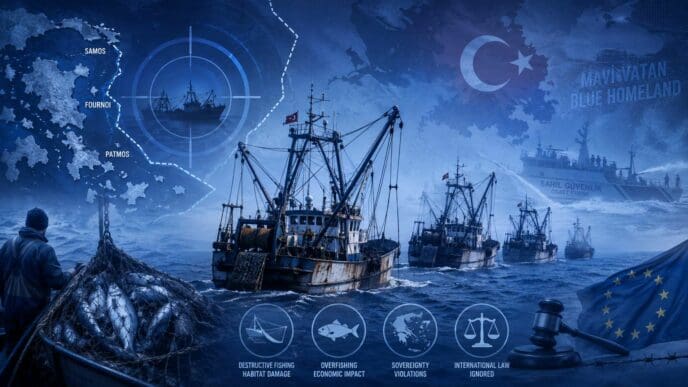
The dispute extends beyond territorial waters into Exclusive Economic Zones and continental shelf rights. The discovery of significant offshore gas reserves in the Eastern Mediterranean transformed these disagreements into high-stakes geopolitical contests. Greece insists that its islands generate full maritime rights under international law. Turkey rejects this interpretation, particularly regarding islands situated very close to its coastline.
Turkish President Recep Tayyip Erdoğan has repeatedly emphasized Ankara’s determination to defend what it calls its “Blue Homeland” doctrine — a strategic concept asserting expansive Turkish maritime rights in surrounding seas. “Turkey will not surrender to attempts to imprison it along its coastline,” Erdoğan declared during heightened tensions in the Eastern Mediterranean.
For Greece, Turkish maritime claims are viewed as revisionist and destabilizing. Former Greek Foreign Minister Nikos Dendias once remarked, “Greece will defend its sovereign rights in accordance with international law and European principles.”
Cyprus: The Island Divided
No issue symbolizes the regional conflict more profoundly than Cyprus. The island remains divided more than five decades after the Turkish military intervention of 1974.
The crisis began when a coup backed by Greece’s military junta attempted to annex Cyprus to Greece. Turkey responded militarily, invoking its status as a guarantor power under the 1960 treaties governing Cyprus. Turkish forces captured the northern third of the island, leading to the displacement of thousands and the effective partition of Cyprus.
Today, the southern portion of the island constitutes the internationally recognized Republic of Cyprus and is a member of the European Union. The northern section remains under the control of the self-declared Turkish Republic of Northern Cyprus, recognized only by Turkey. A United Nations buffer zone still divides the island and even cuts through the capital city of Nicosia.
For Greek Cypriots, the Turkish military presence represents occupation. For Turkey and Turkish Cypriots, the intervention is viewed as a legitimate security operation that prevented ethnic conflict and protected Turkish Cypriot rights.
The failure of repeated peace negotiations underscores the depth of mistrust. Greek Cypriots generally support a reunified federal Cyprus, while Turkey increasingly advocates a two-state solution recognizing the political separation of the island.
Former UN Secretary-General Kofi Annan once warned, “Cyprus cannot remain forever divided in the heart of the European Union.” Yet despite decades of diplomacy, the island remains one of the world’s most enduring frozen conflicts.
Energy Politics and Strategic Competition
The discovery of large offshore natural gas reserves transformed the Eastern Mediterranean into a major geopolitical battleground. Cyprus, Greece, Israel and Egypt developed energy cooperation frameworks aimed at exploiting regional gas resources and building export infrastructure toward Europe.
Turkey viewed these initiatives as attempts to isolate and strategically contain Ankara. In response, Turkey dispatched drilling ships and naval escorts into disputed waters, escalating tensions dramatically. Turkish maritime agreements with Libya further intensified the conflict by challenging Greek maritime claims.
Energy competition thus merged with wider geopolitical rivalries. The Eastern Mediterranean became increasingly linked to Europe’s energy diversification efforts, especially amid attempts to reduce dependence on Russian energy supplies.
French President Emmanuel Macron strongly supported Greece and Cyprus during periods of heightened tension, stating, “The Mediterranean cannot become a playground for unilateral ambitions.”
The energy issue also deepened military alignments. Greece expanded defence partnerships with France, Israel and the United States, while Turkey accelerated its indigenous defence production and naval modernization programs.
Airspace, Militarization and Military Brinkmanship
The rivalry increasingly manifests through military signalling and operational confrontations. Greek and Turkish fighter aircraft frequently intercept one another over disputed airspace, creating the constant risk of accidents or escalation. Naval deployments, military exercises and surveillance operations have become routine.
Another contentious issue concerns the militarization of Greek islands near Turkey’s coastline. Turkey argues that earlier treaties required these islands to remain demilitarized. Greece counters that Turkish military deployments and threats necessitate defensive measures.
The military balance itself has evolved significantly. Greece has modernized its armed forces through acquisitions of advanced French Rafale fighter jets, naval systems and expanded defence cooperation with Western partners. Turkey, meanwhile, has emerged as a major drone warfare power and continues to invest heavily in indigenous missile, aerospace and naval capabilities.
This growing militarization reflects broader strategic anxieties. Both sides fear strategic encirclement and erosion of deterrence credibility.
Migration and Political Pressure
Migration has emerged as another instrument of geopolitical leverage. Turkey hosts millions of refugees, primarily from Syria, and has periodically accused Europe of failing to share the burden equitably. Greece, however, accuses Turkey of facilitating migrant flows toward Greek islands and borders as a means of political pressure.
The migration issue intensified tensions between Turkey and the European Union, further complicating the broader geopolitical environment surrounding Greece and Cyprus.
NATO’s Internal Fault Line
One of the paradoxes of the dispute is that Greece and Turkey are both NATO members. Yet their rivalry constitutes one of the alliance’s most dangerous internal divisions. NATO’s ability to manage crises between its two members remains limited because the disputes concern sovereignty, territorial rights and deeply emotional national narratives.
The United States has consistently attempted to prevent escalation while avoiding complete alignment with either side. Washington views both countries as strategically important for regional stability, Black Sea security and Middle Eastern operations.
However, shifting geopolitical dynamics increasingly complicate this balancing act. Russia’s regional presence, European energy concerns, Middle Eastern instability and emerging Indo-Mediterranean alignments have elevated the strategic significance of the Eastern Mediterranean far beyond a localized regional dispute.
The Future of the Conflict
Despite recurring diplomatic efforts and temporary periods of détente, none of the fundamental disputes between Turkey, Greece and Cyprus have been resolved. Maritime boundaries remain contested; Cyprus remains divided and military mistrust persists.
Yet outright war remains unlikely because of several restraining factors. NATO membership, economic interdependence, tourism revenues and the potentially catastrophic consequences of military conflict all act as deterrents against full-scale confrontation.
Still, the possibility of crises remains very real. A naval collision, airspace incident or contested drilling operation could rapidly escalate tensions. In an era of rising nationalism and intensifying geopolitical competition, the Eastern Mediterranean remains a region where local disputes can quickly acquire international consequences.
As geopolitical analyst Robert Kaplan once noted, “Geography has been the primary force behind the destiny of nations.” In the Eastern Mediterranean, geography continues to shape strategy, identity and conflict with remarkable intensity.
The Turkey-Greece-Cyprus dispute is therefore not merely a regional disagreement over islands and maritime boundaries. It is a complex struggle involving history, sovereignty, energy security, military deterrence and competing visions of regional order. Until these deeper structural tensions are addressed, the Eastern Mediterranean will remain one of the world’s most strategically fragile fault lines.
India’s Expanding Role in the Eastern Mediterranean
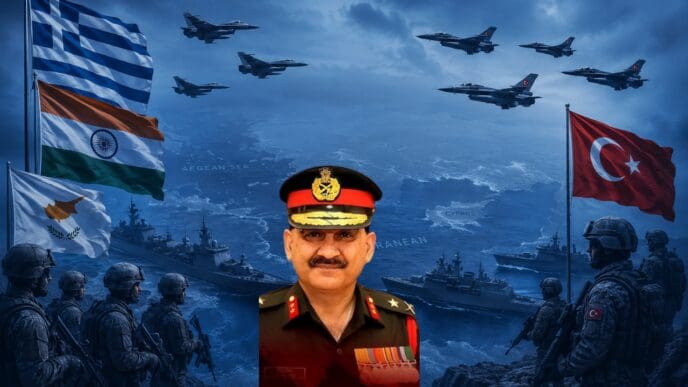
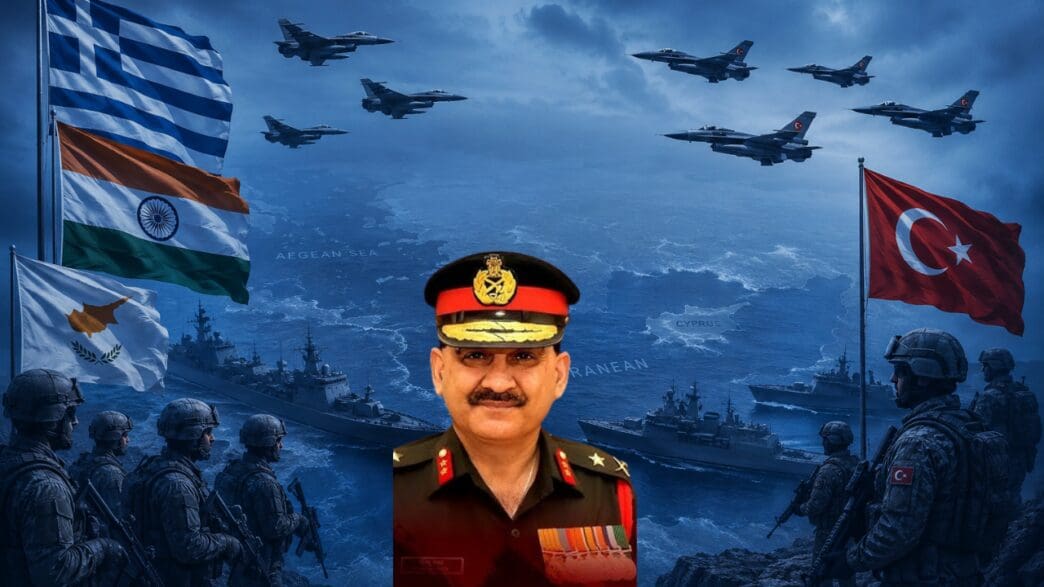
An increasingly important dimension of the Eastern Mediterranean geopolitical landscape is the growing strategic engagement between India, Greece and Cyprus. What was once a distant diplomatic relationship has gradually evolved into a wider strategic convergence shaped by maritime interests, defence cooperation, connectivity initiatives and shared concerns regarding regional security dynamics.
For decades, India maintained a relatively low strategic profile in the Mediterranean. However, the changing global balance of power, the rise of Indo-Pacific geopolitics and Turkey’s increasingly close alignment with Pakistan have altered New Delhi’s strategic calculations. India today views Greece and Cyprus not merely as European partners but as important gateways into the Mediterranean and broader European strategic architecture.
The relationship has acquired particular momentum in recent years. Prime Minister Narendra Modi and Greek Prime Minister Kyriakos Mitsotakis elevated bilateral ties to a strategic partnership, emphasizing defence, maritime security, trade connectivity and technology cooperation. India’s outreach reflects its ambition to emerge as a multi-regional strategic actor capable of operating beyond the Indian Ocean.
Greece occupies a strategically critical location linking Europe, the Mediterranean and the Middle East. For India, Athens offers an important maritime and logistics partner in the context of emerging connectivity initiatives such as the India-Middle East-Europe Economic Corridor. Cyprus, meanwhile, holds immense geopolitical value because of its location at the crossroads of major sea lanes connecting Europe, West Asia and North Africa.
India’s growing engagement with both countries also reflects geopolitical signalling toward Turkey. Ankara’s repeated support for Pakistan on Kashmir and its expanding military relationship with Islamabad have generated unease in New Delhi. Turkish drones, defence technology cooperation and political backing for Pakistan during India-Pakistan crises have contributed to India reassessing Turkey’s role in regional security dynamics.
Against this backdrop, India’s defence cooperation with Greece and Cyprus has assumed increasing strategic significance.
Defence Cooperation Between India and Greece
India and Greece have substantially expanded military engagement through naval exercises, defence dialogues and discussions on defence industrial cooperation. The Indian Navy’s increasing operational presence in the Mediterranean has reinforced maritime interoperability between the two countries.
Greek interest in Indian defence technologies has grown alongside Athens’ efforts to modernize its military capabilities in response to Turkish military expansion and assertive maritime policies. India’s emergence as a major missile and drone producer has made Indian systems increasingly attractive because of their cost-effectiveness and operational credibility.
Particular attention has focused on the possibility of India offering advanced missile systems and long-range strike capabilities to Greece. Though several reports remain speculative and not officially confirmed, Turkish strategic circles have expressed concern regarding potential Indian-origin cruise missile deployments in the Eastern Mediterranean.
For Greece, Indian defence cooperation offers strategic diversification beyond traditional Western suppliers. Athens seeks to strengthen deterrence capabilities while avoiding excessive dependence on a limited set of partners. India, meanwhile, gains an entry point into the European defence market and an opportunity to project strategic influence into the Mediterranean.
Military exercises between the two countries have also acquired symbolic significance. Joint naval operations reinforce India’s image as a maritime power willing to engage in security partnerships beyond the Indo-Pacific. Greece views India as a rising strategic actor capable of contributing to regional balance and maritime stability.
As Greek Prime Minister Kyriakos Mitsotakis stated during discussions on bilateral cooperation, “Greece sees India as a strategic partner with a growing global role and a shared commitment to stability and international law.”
India-Cyprus Relations and Strategic Significance
India’s relationship with Cyprus carries both historical and contemporary significance. Cyprus has traditionally supported India on issues such as Kashmir at international forums, while India has backed the sovereignty and territorial integrity of Cyprus.
In recent years, the strategic dimension of the relationship has grown considerably. Cyprus views India as a rising global power and a potential defence and investment partner. For New Delhi, Cyprus offers an important foothold in the Eastern Mediterranean and an avenue for engagement with European maritime structures.
Defence cooperation discussions reportedly include interest in Indian missile systems, air defence platforms and surveillance technologies. Cyprus seeks to strengthen its deterrence posture amid continuing tensions with Turkey and concerns regarding Turkish naval activity in the Eastern Mediterranean.
The possibility of Indian defence exports to Cyprus has attracted particular attention because of the symbolic implications. Any significant Indian military cooperation with Cyprus is viewed in Ankara not merely as an arms relationship but as a geopolitical signal that India is willing to engage more actively in Turkey’s strategic neighbourhood.
India’s defence industry ambitions also align with these developments. New Delhi seeks to expand defence exports under its broader strategic vision of becoming a major global arms producer. Cooperation with Greece and Cyprus provides India with opportunities to showcase indigenous platforms including missile systems, surveillance equipment, drones and maritime technologies.
Strategic Implications for the Regional Balance
India’s expanding defence ties with Greece and Cyprus contribute to a broader strategic balancing framework emerging in the Eastern Mediterranean. Alongside France, Israel and the United States, India is increasingly viewed as part of a wider network of states indirectly supporting Greece and Cyprus against perceived Turkish assertiveness.
For Turkey, this trend is strategically uncomfortable because it internationalizes disputes Ankara historically sought to manage within regional or NATO frameworks. Indian involvement introduces a major Asian power into Mediterranean geopolitics, linking South Asian strategic rivalries with Eastern Mediterranean tensions.
At the same time, India is unlikely to become directly entangled in regional military confrontations. New Delhi continues to pursue strategic autonomy and avoids formal alliance structures. Its approach is therefore calibrated — enhancing partnerships, expanding defence diplomacy and increasing strategic presence without crossing into overt bloc politics.
Nevertheless, India’s growing role reflects an important geopolitical transformation. The Eastern Mediterranean is no longer merely a regional theatre confined to Europe and the Middle East. It is becoming increasingly connected to Indo-Pacific geopolitics, global trade corridors and emerging multi-regional strategic alignments.
As India expands its naval reach, defence exports and geopolitical footprint, its partnerships with Greece and Cyprus are likely to deepen further. For Greece and Cyprus, India offers technological cooperation, strategic diversification and diplomatic support. For India, the relationship provides strategic access, geopolitical leverage and a stronger role in shaping the emerging security architecture of the wider Mediterranean region.
Maj Gen Dr Rajan Kochhar is a distinguished former officer of the Indian Army, strategic affairs analyst and author with extensive experience in national security, military logistics and geopolitical studies. Over the course of a long military career, he served in key operational and staff appointments, gaining deep insight into India’s defence preparedness, border management and strategic environment.
He has written extensively on contemporary security challenges, hybrid warfare, India’s military modernization, regional geopolitics and emerging defence technologies. His analytical work frequently examines the intersection of strategy, diplomacy and military affairs, with particular focus on South Asia, the Indo-Pacific and evolving global power dynamics.
Maj Gen Dr Rajan Kochhar is also associated with academic and policy-oriented research on defence and international relations. His writings reflect a blend of operational military experience and strategic scholarship, making his work relevant to policymakers, defence professionals and students of geopolitics alike.
As an author and commentator, he is known for presenting complex strategic issues in a clear and structured manner while offering balanced assessments of regional and global security developments.