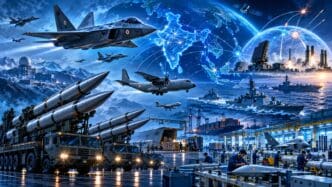
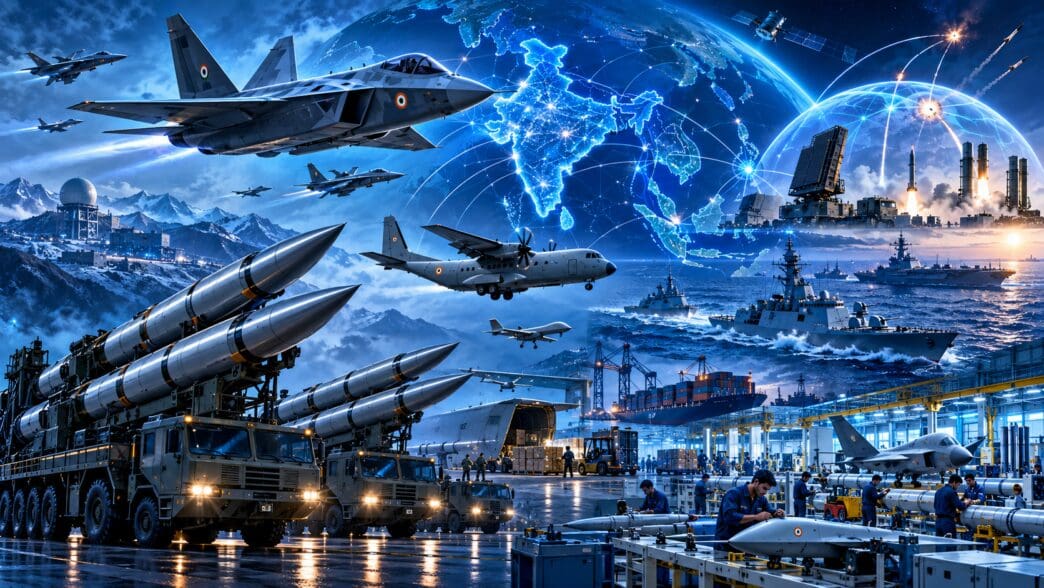
India is no longer content with being one of the world’s largest buyers of foreign weapons. New Delhi is attempting something far more ambitious: the construction of a broad, technologically advanced, export-oriented defence-industrial power capable of shaping the military balance across the Indo-Pacific.
The scale of the transformation is becoming increasingly visible.
From the expansion of the BrahMos supersonic cruise missile programme and the development of the fifth-generation Advanced Medium Combat Aircraft (AMCA), to ballistic missile defence tests, indigenous warship construction, private-sector aerospace manufacturing and record arms exports, India is building the foundations of a military-industrial ecosystem designed for the next several decades.
At the same time, New Delhi is deepening defence cooperation with partners such as Australia, expanding its naval footprint across the Indian Ocean and strengthening strategic deterrence against both China and Pakistan.
The central objective is increasingly clear:
India wants to move from strategic dependence to strategic autonomy — and from strategic autonomy to global defence influence.
The scramjet breakthrough: India pushes toward hypersonic strike
One of the most consequential developments concerns India’s progress in hypersonic propulsion.
The Defence Research and Development Laboratory in Hyderabad reportedly achieved a scramjet combustor run exceeding 1,200 seconds, significantly surpassing an earlier 700-second test.
That number matters.
For an operational hypersonic cruise missile, sustained combustion at extreme speed and temperature is one of the most difficult technological challenges. A scramjet engine must function while air moves through the combustion chamber at supersonic velocity, while temperatures and pressure conditions place extraordinary demands on fuel, coatings and materials.
India’s programme uses an indigenous liquid hydrocarbon endothermic fuel combined with a high-temperature thermal barrier coating.
The strategic importance goes well beyond laboratory prestige.
With the long-discussed BrahMos-II hypersonic programme still facing delays, the scramjet effort represents one of India’s most credible pathways toward an indigenous hypersonic strike capability.
If New Delhi succeeds, it could eventually field weapons capable of penetrating increasingly sophisticated air and missile-defence networks at extremely high speed.
That would substantially alter the regional strike equation.
Agni MIRV: India strengthens its strategic deterrent
India is also advancing the most sensitive layer of its strategic arsenal.
In May 2026, India flight-tested an advanced Agni ballistic missile equipped with Multiple Independently Targetable Re-entry Vehicle technology, or MIRV.
The technology allows a single ballistic missile to deploy multiple re-entry vehicles toward separate targets.
This is strategically significant because MIRV-capable missiles complicate missile defence, increase target coverage and make a nuclear force more survivable and credible.
The test followed Mission Divyastra in 2024, India’s earlier publicly acknowledged MIRV demonstration.
Although the specific Agni variant was not officially identified in the material, the broader strategic direction is difficult to miss.
India’s nuclear modernisation is increasingly focused not only on Pakistan but also on the much larger challenge posed by China’s expanding nuclear and missile forces.
New Delhi’s deterrence doctrine is therefore becoming more sophisticated, with longer-range delivery systems, advanced re-entry technologies and improved survivability.
China remains the strategic driver
Many of India’s defence programmes can be understood only through the prism of China.
The unresolved Line of Actual Control, the rapid expansion of the People’s Liberation Army, the growth of the Chinese Navy in the Indian Ocean and Beijing’s technological progress have all forced New Delhi to reconsider the scale and speed of its military modernisation.
Diplomatic channels remain open.
India and China continued consultations over their disputed border in 2026, building on previous disengagement arrangements and efforts to stabilise bilateral ties.
But dialogue has not eliminated strategic rivalry.
India is simultaneously trying to reduce the risk of border escalation while preparing for the possibility of a much wider military competition with China over the coming decades.
That explains the emphasis on missiles, surveillance, air defence, long-range aviation, naval power and strategic infrastructure in the Indian Ocean.
AMCA: India’s fifth-generation fighter enters a decisive phase
Perhaps no programme better symbolises India’s long-term aerospace ambition than the Advanced Medium Combat Aircraft.
The AMCA is intended to become India’s indigenous fifth-generation combat aircraft, incorporating stealth, advanced sensors, networked warfare capabilities and next-generation weapons.
Progress on the programme has moved into an important industrial phase.
Major Indian companies including Tata Advanced Systems, Larsen & Toubro, Bharat Electronics, Bharat Forge and others have been associated with industrial groupings competing for participation in the development effort.
The most significant element is the growing role of the private sector.
For decades, India’s military aerospace sector was dominated by state-owned Hindustan Aeronautics Limited. The emerging AMCA model reflects New Delhi’s desire to create a broader competitive industrial ecosystem rather than rely on a single state aerospace champion.
The selected industrial partner is expected to work with the Aeronautical Development Agency on multiple flying prototypes and a structural test aircraft.
The schedule remains ambitious, with a first flight targeted in the early 2030s and deliveries expected later in the decade.
The challenge will be enormous.
India must master stealth shaping, propulsion, sensors, electronic warfare, advanced manufacturing and weapons integration while avoiding the delays that have affected previous aerospace projects.
If AMCA succeeds, however, India will cross a critical threshold from fighter-aircraft operator to genuine designer of high-end combat aviation technology.
BrahMos at 25: From Indo-Russian project to Indian strategic brand
The BrahMos programme remains one of India’s most visible defence achievements.
Originally developed through cooperation between India’s DRDO and Russia, the missile has matured into a central strike weapon for the Indian Armed Forces.
It is deployed in land, sea and air-launched configurations and combines high speed with precision strike capability.
But BrahMos is now becoming something more: a geopolitical instrument of Indian foreign policy.
The Philippines became the first major export customer, while other Southeast Asian states have shown serious interest.
The strategic logic is obvious.
Selling BrahMos does not merely generate export revenue. It builds long-term defence relationships, training requirements, maintenance networks and strategic dependencies.
For countries facing maritime pressure in the Indo-Pacific, BrahMos also offers a powerful coastal-denial capability.
Its expansion into Southeast Asia therefore carries unmistakable geopolitical weight.
India is no longer simply exporting a missile.
It is exporting influence.
Australia and India move closer on defence production
Another major element of India’s strategy is the deepening of defence cooperation with Australia.
The two countries have strengthened dialogue on maritime security, technology and industrial cooperation, with discussions moving toward an agreement covering defence articles and services.
The importance lies in the prospect of co-production rather than simple buyer-seller relations.
India and Australia share growing concerns over maritime security, supply-chain vulnerability and the strategic balance in the Indo-Pacific.
Their cooperation could expand into surveillance systems, maritime-domain awareness, sensor technology, research and joint exercises.
India’s expected deeper participation in future editions of Exercise Talisman Sabre would further strengthen interoperability.
For New Delhi, defence-industrial cooperation with Australia offers strategic diversification.
For Canberra, India represents a massive industrial and military partner with a central geographic position in the Indian Ocean.
C-295: India breaks an old aerospace monopoly
The C-295 programme has become another symbol of India’s changing industrial model.
The first C-295 transport aircraft assembled in India from the Tata-Airbus facility in Vadodara represents a historic transition.
For the first time, a private Indian company is producing a complete military aircraft at this scale.
That matters because the significance of the programme extends beyond the aircraft itself.
The C-295 programme is creating supply chains, manufacturing expertise, quality-control systems and skilled aerospace employment outside the traditional state sector.
Dozens of Indian suppliers are being integrated into the production ecosystem.
The aircraft will replace the ageing Avro HS-748 fleet, but the broader industrial objective is far larger.
India wants domestic aerospace manufacturing to become normal rather than exceptional.
This is a crucial distinction.
Licensed manufacturing is not the same as complete technological sovereignty, but it can serve as a bridge toward indigenous design capability.
The challenge will be converting assembly experience into design ownership.
Missile defence becomes a national priority
India is also strengthening its shield against ballistic threats.
DRDO has carried out tests involving the AD-1 and AD-2 interceptor families, part of a broader multi-layered ballistic missile-defence architecture.
The strategic importance is immense.
India faces both regional ballistic missile threats and the longer-term challenge posed by increasingly sophisticated Chinese systems.
A layered shield capable of intercepting missiles at different altitudes could protect major cities, strategic command infrastructure and critical military facilities.
This effort also connects with the broader Mission Sudarshan Chakra concept, which seeks to build a more integrated national air and missile-defence network.
The programme is expected to combine interceptors, sensors, radars, command systems and advanced detection technologies.
If successfully matured, India could develop one of Asia’s most sophisticated missile-defence architectures.
The Navy becomes central to India’s great-power strategy
The Indian Navy is also undergoing a major transformation.
The commissioning of domestically built platforms — including stealth frigates, survey vessels and anti-submarine warfare ships — demonstrates the growing maturity of India’s naval shipbuilding sector.
The significance is not simply numerical.
India wants to dominate its immediate maritime environment, secure vital sea lanes and maintain the ability to operate from the Arabian Sea to the eastern Indian Ocean.
Great Nicobar is becoming increasingly important in this strategy because of its location near critical sea routes connecting the Indian and Pacific Oceans.
The broader objective is clear:
India wants the Indian Ocean to remain a strategic space in which New Delhi possesses decisive influence.
That means more frigates, submarines, maritime patrol aircraft, surveillance networks and anti-submarine capabilities.
It also means greater cooperation with Australia, Japan, the United States and other Indo-Pacific partners.
Indigenous marine turbines: The hidden battle for autonomy
One of the less glamorous but highly important aspects of India’s defence transformation concerns propulsion and power-generation systems.
India has signed contracts for indigenous marine gas-turbine generator sets intended to power critical systems aboard naval vessels.
This reflects a fundamental lesson.
A country can build impressive ships, missiles and aircraft, but if engines, turbines, microelectronics or key subcomponents remain dependent on foreign suppliers, strategic autonomy remains incomplete.
The real test of self-reliance is therefore not the percentage of a platform assembled domestically.
It is whether India controls the technologies without which the platform cannot fight.
That includes propulsion, sensors, radars, guidance systems, seekers, semiconductors, software and high-end materials.
Defence exports cross a new threshold
Perhaps the clearest indicator of change is the surge in Indian defence exports.
Exports reportedly reached ₹38,424 crore, or around $4.1 billion, in FY2025-26, representing a dramatic year-on-year increase.
Indian defence products now reach dozens of countries.
The private sector accounts for a major share, reflecting an industrial transformation that would have been difficult to imagine two decades ago.
This is important economically, but it is even more important strategically.
Defence exports create long-term political relationships.
They generate training agreements, spare-parts chains, technical support obligations and interoperability.
When a country adopts your missile, radar or naval platform, the relationship can last decades.
India understands this.
Weapons exports are becoming an instrument of statecraft.
Defence production reaches record levels
Domestic defence production has also climbed to historic levels.
The government’s Atmanirbhar Bharat strategy is designed to shift India away from dependence on foreign weapons and toward indigenous production.
The policy is increasingly backed by procurement reform, private-sector participation and incentives for domestic development.
But the real challenge remains technological depth.
India can increase production volumes dramatically without necessarily achieving full sovereignty over critical technologies.
The question is therefore not just how much India manufactures.
It is how much India truly owns.
The nuclear balance is evolving
India’s nuclear arsenal is also expanding.
SIPRI estimates cited in the material suggest that India’s nuclear stockpile has grown, while New Delhi continues to invest in longer-range and more sophisticated delivery systems.
The trajectory reflects India’s dual deterrence problem.
Pakistan remains an immediate nuclear competitor.
China, however, represents the long-range strategic challenge.
That reality is reshaping missile ranges, submarine programmes, MIRV development and strategic command planning.
India’s deterrence architecture is becoming increasingly oriented toward ensuring survivability and retaliatory capacity against a much larger peer competitor.
The deeper transformation: From buyer to system creator
The most important shift in Indian defence policy is conceptual.
For decades, India was defined by its ability to purchase, adapt and operate a mix of Russian, Western and indigenous systems.
That model is changing.
New Delhi now wants to become a designer, integrator, producer and exporter.
BrahMos, AMCA, C-295, missile defence, indigenous frigates, drones and advanced propulsion systems are all components of the same strategic project.
The objective is not simply self-reliance for its own sake.
It is power.
Industrial capacity determines how long a country can sustain a conflict.
Technological autonomy determines whether sanctions or supply disruptions can cripple operations.
Export capability creates political influence.
Naval and missile strength expand deterrence.
And advanced aerospace capability determines whether a country can compete at the top level of military technology.
India’s 2047 vision: The real endgame
New Delhi’s long-term ambitions reach well beyond the current decade.
Indian officials have spoken openly about building a self-reliant, integrated, all-domain force capable of projecting power across the Indo-Pacific and beyond.
Domestic defence production is targeted to rise dramatically by 2047, while exports are expected to multiply.
This is not a modest modernisation programme.
It is an attempt to redefine India’s place in the global strategic system.
The biggest obstacles remain substantial: engine technology, semiconductor dependence, advanced materials, procurement delays, programme management and the challenge of converting licensed production into genuine indigenous intellectual property.
But the trajectory is unmistakable.
India no longer wants to be the world’s defence customer. It wants to become one of the world’s defence suppliers — and eventually one of its principal military-industrial powers.
If New Delhi succeeds in integrating missile technology, aerospace, naval power, private industry, advanced electronics and strategic exports into a coherent national ecosystem, the consequences will be felt far beyond South Asia.
They will shape the balance of power from the Arabian Sea to the Western Pacific.
And that is why India’s defence transformation is no longer merely an Indian story.
It is becoming one of the defining strategic stories of the Indo-Pacific.