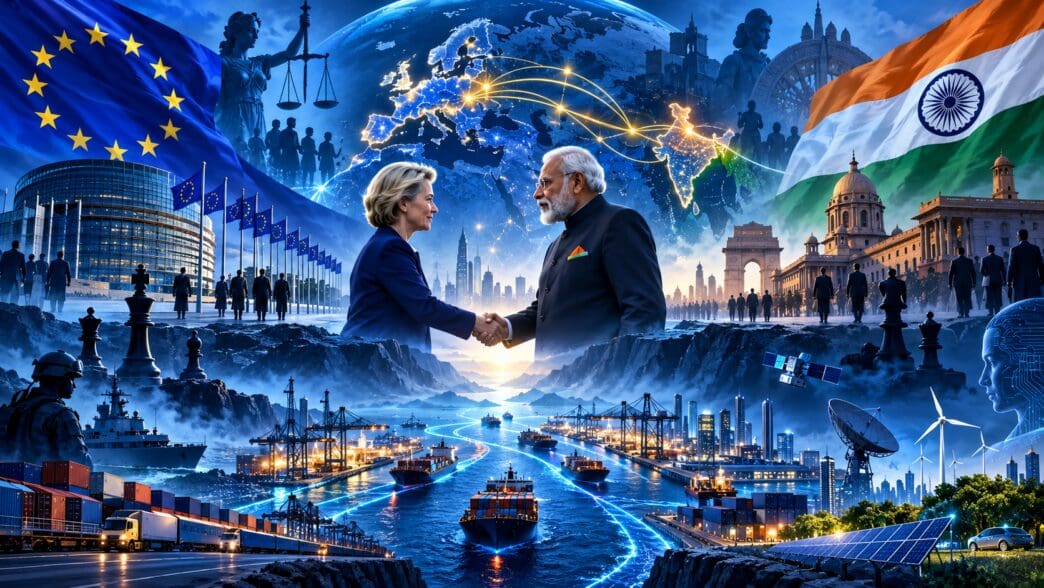
The European Union and India are moving closer at a speed few would have predicted a decade ago.
Trade, defence, technology, maritime security and supply-chain resilience are rapidly becoming pillars of a much broader strategic relationship. The political conclusion of negotiations over the long-awaited EU–India free trade agreement, announced on January 27, 2026, together with progress on a new Security and Defence Partnership, appeared to confirm that Brussels and New Delhi are entering a new era.
On paper, the language is almost perfectly aligned.
Both sides speak about democracy, sovereignty, strategic autonomy, multilateralism and the rules-based international order.
But beneath that diplomatic vocabulary lies a much deeper reality:
Europe and India often use the same words while meaning very different things.
That distinction could become one of the most important strategic questions shaping their partnership.
Sovereignty: Europe wants to pool it, India wants to protect it
The difference begins with history.
Modern Europe emerged from the devastation of two world wars and from the conclusion that absolute national sovereignty could become dangerous when left unconstrained.
The post-war European order therefore moved toward treaties, supranational institutions, international courts and eventually the European Union itself.
For Brussels, sovereignty can be shared, constrained and pooled.
The logic is straightforward: individual states surrender some freedom of action in exchange for greater collective strength.
India comes from almost the opposite historical experience.
Its modern state was born from colonial domination and a long struggle to regain political independence.
For New Delhi, sovereignty was not something that first needed to be limited.
It had to be recovered.
That historical memory still shapes Indian strategic thinking today. Non-interference, policy independence and freedom from external pressure remain central elements of its worldview.
This is why policies that European officials may view as legitimate international standards can sometimes be received much more cautiously in India.
Brussels may see labour requirements, environmental rules or governance conditions as universal norms.
New Delhi may ask a very different question:
Who has the authority to define those norms, and who gets to enforce them?
Strategic autonomy: Same slogan, opposite strategic instincts
Nowhere is the conceptual divide clearer than in the phrase “strategic autonomy.”
Europe has embraced the term increasingly since the 2016 EU Global Strategy and the economic shocks that followed the COVID-19 pandemic.
For Brussels, strategic autonomy generally means reducing dangerous dependencies while increasing Europe’s capacity to act.
But it does not necessarily mean abandoning alliances.
In fact, the European vision often seeks to make Europe a stronger and more capable partner inside collective structures.
India’s understanding goes much deeper.
Its roots stretch back to Jawaharlal Nehru, non-alignment and India’s refusal to become permanently tied to either Cold War bloc.
Today that tradition has evolved into something closer to multi-alignment.
New Delhi wants relationships with Washington, Moscow, Brussels and other centres of power — but it does not want any single partner to dictate its strategic choices.
That creates a fundamental difference.
Europe pools sovereignty to increase strategic autonomy. India protects sovereignty to preserve strategic autonomy.
Europe often wants enough power to make alliances stronger.
India wants enough freedom to ensure alliances never become permanent constraints.
The phrase is identical.
The strategic philosophy is not.
The global order: Brussels wants protection, New Delhi wants reform
Another major difference appears in the debate over multilateralism.
European states generally focus on protecting international institutions.
The European Union sees the United Nations, international courts, the World Trade Organization and major treaty systems as barriers against a return to unrestricted great-power politics.
India does not reject multilateralism.
But it increasingly demands “reformed multilateralism.”
That adjective matters.
New Delhi argues that many international institutions still reflect the global power structure of the mid-20th century rather than the realities of the 21st.
The United Nations Security Council is the clearest example.
India is now one of the world’s most important political, demographic and economic powers, yet it remains outside the permanent membership structure of the Security Council.
For New Delhi, that is not simply a procedural anomaly.
It is evidence of a larger problem.
The international system often demands that rising powers respect rules they had little role in designing.
Europe therefore tends to ask:
Are international institutions being respected?
India increasingly asks:
Who created those institutions, and why should today’s balance of power still be governed by yesterday’s hierarchy?
The “rules-based order” is not interpreted equally
The same divide appears around the phrase “rules-based international order.”
European governments often regard international rules as protection against arbitrary power.
Treaties and institutions can theoretically prevent stronger states from imposing their will on weaker ones.
India broadly accepts the importance of international law.
But New Delhi is often more sceptical about how rules are written and applied.
Its concern is not simply whether rules exist.
It is whether they are applied consistently, interpreted fairly and protected from geopolitical double standards.
This helps explain why India can frustrate Western governments in major international disputes even while describing itself as a supporter of international law.
Why the EU–India partnership will still grow
These differences do not mean the relationship is doomed.
Quite the opposite.
The strategic incentives for cooperation are becoming stronger.
Both sides want more resilient supply chains.
Both worry about excessive economic dependence.
Both seek technological and industrial strength.
Both have major interests in maritime security.
Both are attempting to navigate intensifying competition between the United States and China.
Europe sees India as a massive market, a technology partner and an indispensable Indo-Pacific actor.
India sees Europe as a source of investment, technology, markets and strategic diversification.
Those interests are real — and they are powerful.
The real test: Can Brussels and New Delhi understand each other?
The danger is not disagreement.
The danger is assuming agreement exists simply because both sides use identical language.
When Brussels talks about sovereignty, it often thinks about sharing power.
When New Delhi talks about sovereignty, it thinks about retaining freedom of action.
When Europe talks about strategic autonomy, it often seeks stronger collective capability.
When India talks about strategic autonomy, it seeks maximum manoeuvring space.
When Europe talks about multilateralism, it often wants to defend the existing institutional structure.
India wants to reform it.
That distinction will matter enormously as the relationship deepens.
The EU–India partnership may ultimately become one of the defining geopolitical relationships of the coming decades.
But its success will depend on more than trade agreements, defence cooperation and diplomatic declarations.
Brussels and New Delhi will have to understand not only what the other side wants — but what the words they both use actually mean.
That may prove far harder than signing another agreement.
And far more important.