By Andreas Mountzouroulias
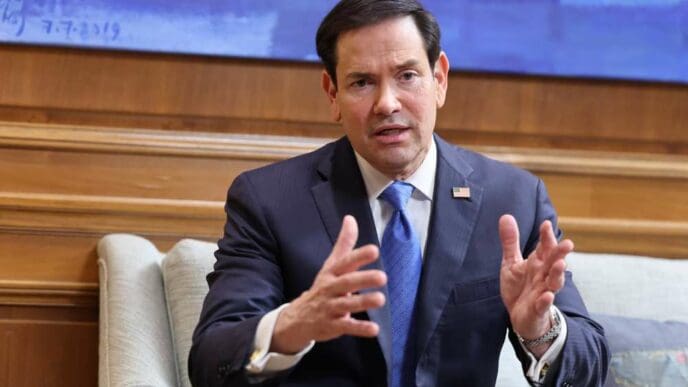
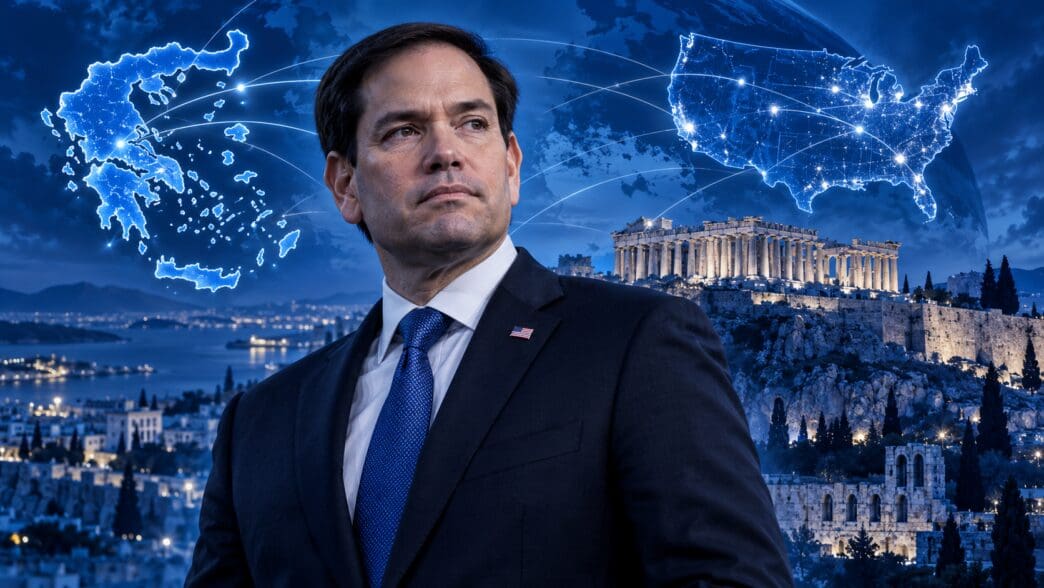
Marco Rubio’s speech from the Pnyx in Athens, with the Acropolis rising behind him, was far more than a ceremonial tribute to ancient Greece.
It was a political manifesto.
A strategic warning.
And, above all, an attempt to explain how Washington now understands the struggle for the future of the West.
Rubio chose one of the most symbolically charged places in the Western world to speak about sovereignty, national identity, military strength, industrial power, technology, energy security and the survival of Western civilization in an age of geopolitical competition. The location mattered because the Pnyx was not merely a historical monument; it was a place where Athenians debated war and peace, power and responsibility, alliances and survival.
That is precisely why Rubio’s message carried much more weight than a conventional diplomatic address.
Ancient Greece provided the ideological language. Modern Greece provided the strategic geography.
And behind the symbolism stood some of the most difficult questions facing the Eastern Mediterranean today: Turkey, the balance of power in the Aegean, Cyprus and the future of the Great Sea Interconnector.
Ancient Greece as the political foundation of the West
Rubio’s central argument was clear.
Ancient Greece should not be treated as a museum civilization.
It should be understood as a living political force.
For Rubio, the Greek legacy gave the West much more than architecture, philosophy and history. It created a vocabulary of political life built around citizenship, reason, excellence, competition, duty, public debate and the pursuit of truth.
That framing matters.
Because Rubio was not simply praising Plato and Aristotle.
He was using the Greek experience to defend a contemporary political doctrine.
His message was that societies become strong when they value achievement.
That nations do not need to apologize for defending their interests.
That national ambition is not automatically aggression.
And that sovereignty is not an outdated relic of the twentieth century.
In this sense, ancient Greece became the intellectual bridge between classical Western thought and a much more modern American concept of national power.
The message to Europe: Wake up
The second layer of Rubio’s speech was directed squarely at Europe.
His warning was stark.
The West is at a crossroads.
The next decade, he argued, will determine whether Western nations remain globally influential or enter a period of relative decline, dependence and strategic weakness.
This is not simply rhetorical pessimism.
It reflects a broader American strategic conclusion: the post-Cold War assumption that economics alone could guarantee peace has collapsed.
The war in Ukraine.
Instability in the Middle East.
The strategic competition between the United States and China.
The vulnerability of energy systems.
The return of large-scale military expenditure.
All of these developments have brought power back to the center of international politics.
Rubio’s message to Europe was effectively that the era of “post-power” is over.
States that cannot defend their borders, maintain industrial capacity, secure energy supplies or support credible armed forces will ultimately depend on others.
Power now means much more than military spending
Rubio’s vision of strength went beyond defense budgets.
He linked national power to industrial capacity, energy, critical supply chains, advanced technology and military readiness.
This is one of the most important ideas in the speech.
The new American definition of sovereignty is not simply territorial.
A state can be formally sovereign and still be strategically dependent if it cannot manufacture critical goods, secure its energy system, protect its digital infrastructure or defend itself militarily.
That is why the United States increasingly treats semiconductors, artificial intelligence, energy routes, defense production and supply chains as matters of national security.
And this is where Greece becomes particularly important.
Why modern Greece fitted Rubio’s message perfectly
Rubio did not speak only about ancient Greece.
He also portrayed modern Greece as a positive example of an ally that matters strategically.
That is where symbolism became geopolitics.
Souda Bay.
Alexandroupolis.
The Aegean.
Cyprus.
The Eastern Mediterranean.
Energy corridors.
NATO.
These are not disconnected issues.
They form a strategic chain.
Greece sits at the intersection of Europe, the Balkans, the Black Sea, the Eastern Mediterranean and the Middle East.
Its geographic position gives it value.
Its growing defense cooperation with the United States gives that geography military substance.
Its role in LNG, regional energy infrastructure and electricity interconnections gives it economic and strategic depth.
Ancient Greece gave Rubio the political vocabulary. Modern Greece gave him the strategic example.
Was there a message to Ankara?
Yes — but it must be understood carefully.
Rubio did not explicitly threaten Turkey.
He did not issue an ultimatum.
He did not publicly frame his Pnyx speech as an anti-Turkish intervention.
That distinction matters.
But there was still an indirect strategic message.
When the U.S. Secretary of State praises Greece as a model ally, emphasizes sovereignty, speaks about regional stability and calls for stronger Western strategic cohesion, those words inevitably resonate in a region where the primary strategic rivalry involving Greece remains the one with Turkey.
The point is not that Washington has chosen confrontation with Ankara.
The point is that Greece today occupies a deeper position inside American strategic planning than it did in previous decades.
That changes the regional equation.
The GSI is the real test
Nowhere is that more evident than in the Great Sea Interconnector.
The GSI is not simply an underwater electricity cable.
It connects Greece and Cyprus.
It carries European strategic importance.
It involves major French commercial interests.
And it could eventually become part of a wider Eastern Mediterranean energy architecture.
The key issue is what happens when survey activity resumes.
Athens’ position is that Turkey may be informed for operational and deconfliction purposes, but permission will not be requested.
That distinction is fundamental.
Information is not recognition.
Coordination is not consent.
And avoiding an incident does not mean accepting another country’s legal claims.
This is precisely where the language of sovereignty becomes practical rather than theoretical.
Ankara’s red line
Turkey, for its part, has repeatedly signaled that it rejects activities in areas it considers part of its continental shelf unless Ankara is consulted and gives approval.
That creates a potentially dangerous collision of legal and strategic positions.
Greece says the project can proceed under its own interpretation of international law.
Turkey argues that its own jurisdiction must be respected.
France has commercial interests through Meridiam and Nexans.
Cyprus needs the project to end its energy isolation.
And the United States has a clear interest in preventing yet another crisis between two NATO allies.
This is why the GSI may become the most important practical test of all the themes Rubio raised at the Pnyx.
Washington’s likely role: Quiet pressure, not public confrontation
The most likely American approach is not public escalation with Ankara.
It is preventive diplomacy.
Washington wants Western-backed strategic infrastructure to move forward.
But it also wants to prevent that infrastructure from becoming the trigger for a Greek-Turkish military confrontation.
That means private messages.
Back-channel diplomacy.
Pressure on both sides to avoid escalation.
And, critically, an effort to prevent a precedent in which Turkish objections become an informal veto over Western projects in the Eastern Mediterranean.
This is where Rubio’s Pnyx message becomes extremely relevant.
He spoke about strong nations cooperating without abandoning sovereignty.
The GSI is almost a perfect real-world test of that doctrine.
Can Greece, Cyprus and their Western partners advance a strategic project without creating a permanent Turkish veto over regional infrastructure?
Two competing energy architectures
The GSI also sits inside a much larger contest.
Turkey is developing its own energy plans linking the Turkish mainland with the occupied northern part of Cyprus.
At the same time, Greece and Cyprus are pushing deeper integration with European energy systems.
The result is the emergence of two competing strategic visions.
One points toward:
Greece – Cyprus – Europe.
The other toward deeper energy integration between:
Turkey – the occupied north – and potentially future Eastern Mediterranean flows.
This is why cables, pipelines and LNG terminals should no longer be seen simply as commercial projects.
They are instruments of influence.
The real contest is over who will shape the energy architecture of the Eastern Mediterranean.
Greek civilization as strategic soft power
Perhaps the most powerful dimension of Rubio’s speech was cultural.
Greece may be a relatively small modern state, but its historical identity gives it an extraordinary reservoir of soft power.
Democracy.
Philosophy.
The citizen.
Reason.
Political participation.
Excellence.
Those ideas still define the language through which much of the West understands itself.
When a U.S. Secretary of State chooses Greece to frame a debate about the future of Western civilization, that is not merely flattery.
It is an acknowledgment that Greek civilization remains part of the political identity of the Western world.
And that gives modern Greece something rare.
A connection between history, identity and strategy.
From Pericles to the geopolitics of the 21st century
There is something almost strikingly symmetrical about the setting.
The ancient Athenians gathered at the Pnyx to debate alliances, fleets, war, peace and survival.
More than two millennia later, an American Secretary of State stood in the same place and spoke again about:
Power.
Sovereignty.
Alliances.
Identity.
Deterrence.
The vocabulary has changed.
The logic of geopolitics has changed far less.
The real message of the Pnyx
Rubio’s speech was not simply a tribute to Greece.
It was a warning to the West.
His central argument was that values alone are not enough.
They must be defended by power.
By military strength.
By energy security.
By industry.
By technology.
By resilient states.
And by alliances built on strategic seriousness rather than symbolism.
For Greece, that creates both opportunity and responsibility.
The challenge is to convert cultural prestige, geography and the strategic relationship with Washington into tangible national power.
For Turkey, Rubio’s message was not a direct ultimatum.
But it was a reminder that Greece is now more deeply embedded in the Western strategic architecture.
And for the GSI, the coming period will show whether the language of the Pnyx — sovereignty, alliances, power and stability — can survive contact with the hard realities of the Eastern Mediterranean.
Because ultimately, that is where Rubio’s speech will be judged.
The Pnyx delivered the historical message. The Aegean, Cyprus and the Eastern Mediterranean will determine whether that message can be translated into strategic reality.