Pakistan occupies one of the most complicated positions in the global struggle against Islamist militancy.
It is simultaneously a victim of terrorism, a battlefield against jihadist organisations, and a country repeatedly accused of having allowed militant networks targeting neighbouring states to survive on its soil.
That contradiction sits at the heart of South Asia’s security crisis.
Pakistani civilians, soldiers, police officers, politicians and religious minorities have suffered heavily from terrorist violence. Yet at the same time, organisations historically based in Pakistani territory — including Lashkar-e-Taiba, Jaish-e-Mohammed and Tehrik-e-Taliban Pakistan — have made the country a central arena in the regional struggle against violent extremism.
The danger goes far beyond domestic terrorism.
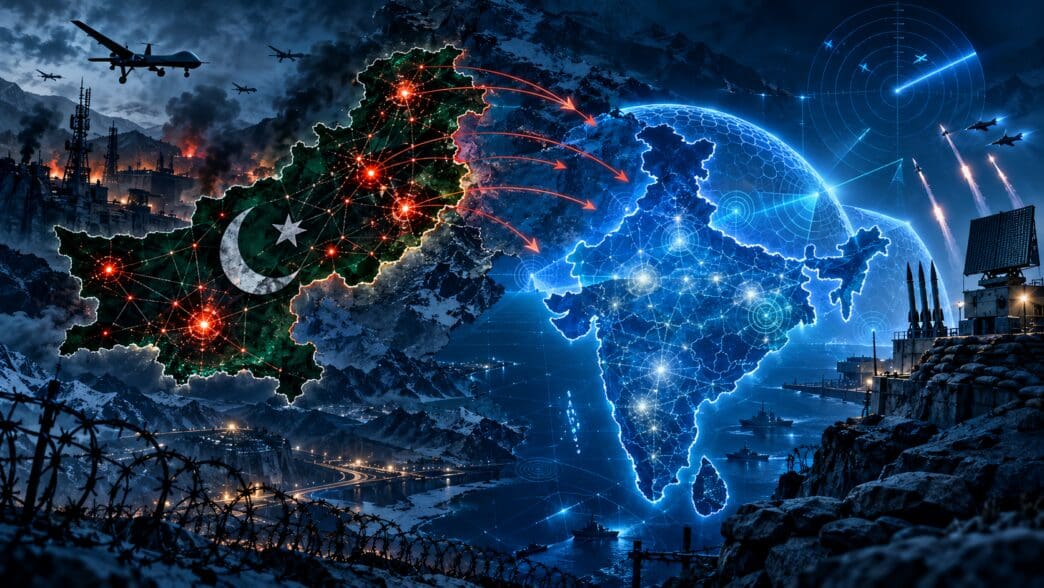
Because India and Pakistan are both nuclear-armed powers, one terrorist attack can become the spark for a military confrontation with consequences far beyond Kashmir or the subcontinent.
That is what makes Pakistan’s radicalisation problem one of the most dangerous security issues in Asia.
The roots of the problem lie in the Afghan jihad
The modern infrastructure of Islamist radicalisation in Pakistan did not emerge overnight.
Its roots go back especially to the 1980s Soviet war in Afghanistan, when Pakistan became a key staging ground for the Afghan jihad.
Weapons, money, fighters and ideological networks moved through the country on a massive scale.
Religious seminaries, militant organisations and recruitment structures expanded during this period.
It is crucial to draw a distinction here: the overwhelming majority of Pakistani religious institutions did not advocate terrorism.
But extremist organisations were able to exploit some religious schools, charities and political-religious networks for recruitment, financing and indoctrination.
When the Soviet Union withdrew from Afghanistan, the infrastructure did not simply disappear.
It adapted.
Some militant groups redirected their attention toward Kashmir and India, while others built relationships with the Taliban, al-Qaeda and later regional jihadist movements.
This is one of the central lessons of modern terrorism.
Networks created for one war rarely vanish when that war ends.
They search for new causes, new battlefields and new enemies.
Lashkar-e-Taiba: The organisation that changed India forever
Among Pakistan-based anti-India organisations, few have had a greater psychological and strategic impact than Lashkar-e-Taiba, or LeT.
The group has been associated with numerous attacks against civilian and military targets and has historically maintained links with broader jihadist networks.
Its most notorious operation was the November 2008 Mumbai massacre.
Ten attackers struck hotels, a railway station, a café and a Jewish centre in a coordinated assault that killed 166 people and wounded more than 300.
The attack was not merely an act of mass murder.
It was a demonstration of operational sophistication.
The gunmen arrived by sea, split into teams and attacked symbolic, civilian and internationally visible locations.
Their objective was not only to kill.
It was to create maximum fear, maximum publicity and maximum political pressure.
Mumbai changed Indian security thinking profoundly.
For New Delhi, the attacks reinforced the belief that terrorism emanating from across the western border was no longer simply a policing problem.
It had become a national security threat capable of triggering military retaliation.
Jaish-e-Mohammed and the danger of escalation
Another organisation at the centre of India-Pakistan tensions is Jaish-e-Mohammed, or JeM.
Founded in 2000 by Masood Azhar, the organisation developed an explicitly militant agenda centred on Kashmir.
It has been linked historically to al-Qaeda, the Taliban and other extremist networks.
JeM and LeT were implicated in the December 2001 attack on the Indian Parliament, an event that pushed India and Pakistan toward a major military confrontation.
Years later, the pattern repeated itself.
In February 2019, a suicide bomber attacked an Indian paramilitary convoy at Pulwama in Jammu and Kashmir, killing more than 40 personnel.
Jaish-e-Mohammed claimed responsibility.
India responded with air strikes near Balakot inside Pakistan, and the crisis quickly escalated into aerial combat between the two countries.
That episode revealed a terrifying reality.
A terrorist organisation does not need nuclear weapons to create nuclear danger.
It only needs to trigger a chain reaction between states that possess them.
Pathankot and Uri: India’s doctrine begins to shift
The attacks did not stop there.
In January 2016, militants attacked the Pathankot Air Force Station in Punjab.
Later that year, an assault on an Indian Army base at Uri killed Indian soldiers and produced another major escalation.
India subsequently announced what it described as “surgical strikes” against militant launch sites across the Line of Control.
This marked an important doctrinal development.
New Delhi was increasingly signalling that major terrorist attacks blamed on Pakistan-based organisations could provoke direct military action rather than diplomatic restraint alone.
That shift fundamentally changed the risk equation.
Every major attack now carried the possibility that India would respond militarily.
And every Indian response created the possibility of Pakistani counteraction.
Pahalgam: The threat did not disappear
The danger remained very real in the following decade.
On April 22, 2025, gunmen attacked tourists near Pahalgam in Indian-administered Kashmir, killing 26 people.
India said the assault had cross-border links and accused Pakistan of responsibility.
Islamabad denied involvement and called for an independent investigation.
A group known as The Resistance Front, which Indian security agencies describe as linked to Pakistan-based militant networks including Lashkar-e-Taiba, was associated with claims surrounding the attack.
The crisis escalated dramatically.
India later struck what it described as terrorist infrastructure inside Pakistan and Pakistan-administered Kashmir, including locations it associated with Jaish-e-Mohammed and Lashkar-e-Taiba.
Pakistan rejected India’s description of the targets and said civilians had been killed.
Once again, the same strategic pattern appeared:
terrorism acted as the trigger, interstate military action followed, and nuclear-armed confrontation became a real possibility.
Pakistan is also fighting its own jihadist war
The Pakistan story becomes even more complex because not all jihadist organisations based in or operating around the country target India.
Tehrik-e-Taliban Pakistan, or TTP, represents the opposite side of the problem.
Its principal enemy is the Pakistani state itself.
TTP has attacked military personnel, police, civilians and government institutions across Pakistan.
This exposes one of the most dangerous realities of extremist mobilisation:
militant organisations cannot always be controlled once they develop their own ideology, financing networks, leadership structures and armed capacity.
A movement that is considered useful in one geopolitical context can later become a threat to the state that tolerated it.
Pakistan has therefore found itself in a paradoxical position.
It has faced international accusations regarding militants targeting neighbouring countries while at the same time fighting a brutal insurgency by extremists targeting Pakistan itself.
Sectarian extremism adds another layer of instability
Pakistan’s militant landscape is not limited to India-focused jihadist groups or the TTP.
The country has also suffered severe sectarian violence.
Lashkar-e-Jhangvi became notorious for attacks against Pakistan’s Shia population, including members of the Hazara community.
The organisation developed ties to al-Qaeda and the Taliban and has been linked to attacks against civilians, religious minorities, Pakistani officials and foreigners.
ISIS-Khorasan has also carried out devastating attacks inside Pakistan, targeting political events, minority communities and security forces.
This means Pakistan is confronting several overlapping extremist ecosystems at once:
anti-India militancy, anti-state jihadism, sectarian terrorism and transnational jihadist activity.
That overlap makes the security picture far more difficult.
The ideological problem is bigger than the organisations
The central danger is not simply the existence of individual terrorist groups.
It is the ideological infrastructure that allows new organisations to emerge even when older ones are weakened.
Radicalisation often begins long before an individual joins a terrorist cell.
It starts with narratives.
The world is divided into believers and enemies.
Compromise becomes betrayal.
Civilians become legitimate targets because they are associated with an opposing government, religion or community.
Violence is transformed from a crime into a religious duty.
That process is what makes jihadist ideology so dangerous.
The weapon is not only the bomb, rifle or suicide vest. The deeper weapon is the belief system that convinces the attacker that killing civilians has become morally justified.
Radical leaders can create the ecosystem for violence
History shows that extremist violence is often preceded by ideological preparation.
Thinkers such as Sayyid Qutb helped develop intellectual frameworks later adopted by radical movements.
Abdullah Azzam became a major figure in global jihadist mobilisation during the Afghan war.
Osama bin Laden transformed extremist ideology into a global terrorist network.
Abu Bakr al-Baghdadi pushed the concept even further by declaring the so-called Islamic State “caliphate” across parts of Iraq and Syria.
In the West, figures such as Anwar al-Awlaki demonstrated how online preaching could radicalise individuals thousands of kilometres away from a physical battlefield.
The point is not that every radical preacher becomes a terrorist commander.
It is that ideas can prepare the psychological and moral environment in which terrorism becomes easier to justify.
The real danger: terrorism and nuclear deterrence
The greatest security threat in South Asia is the intersection of religious extremism, militant organisations, Kashmir, interstate rivalry and nuclear deterrence.
Mumbai in 2008.
Pulwama in 2019.
Pahalgam in 2025.
Each crisis showed a variation of the same pattern.
A relatively small group of attackers can set in motion events involving armies, air forces, missiles and nuclear states.
That is why terrorism in South Asia cannot be viewed solely as a domestic law-enforcement issue.
It is a strategic stability problem.
Pakistan cannot defeat extremism selectively
The long-term answer cannot be military action alone.
Military operations can destroy camps.
Police can arrest operatives.
Intelligence agencies can disrupt plots.
But that is not enough.
Extremist financing networks, recruitment structures, ideological propaganda and organisations operating through charitable or political fronts must also be dismantled.
The principle must be consistent:
terrorism cannot be tolerated when it targets a rival and condemned only when it turns against the state that once ignored it.
Selective counterterrorism is ultimately self-defeating.
Extremist movements mutate, fragment and redirect their violence.
What begins as a tool against an external enemy can eventually become an internal insurgency.
India and Pakistan remain one attack away from crisis
For India, the central strategic challenge is preventing another large-scale attack without triggering uncontrolled escalation.
For Pakistan, the challenge is even broader.
It must suppress extremist networks while convincing the international community that no organisation targeting neighbours enjoys protection or tolerance.
The stakes could hardly be higher.
India and Pakistan have fought wars.
They possess nuclear weapons.
They maintain deep historical hostility.
And they operate in an environment where militant groups can exploit Kashmir, ideology, religion and regional rivalry.
That means a handful of extremists can create a crisis involving hundreds of millions of people.
The final warning
The Pakistan radicalisation issue is not a simple story of one state, one religion or one organisation.
It is a story about how decades of militant infrastructure, ideological mobilisation, regional rivalry and inconsistent counterterrorism can combine into a permanent security threat.
Pakistan itself has paid an enormous price in blood.
That fact must never be ignored.
But neither can the record of Pakistan-based organisations responsible for attacks in India and elsewhere.
The lesson for South Asia is brutally clear:
there can be no “good” terrorism and “bad” terrorism depending on who the target is.
If extremist infrastructure survives, it eventually develops its own logic.
If ideological networks remain intact, new organisations can replace old ones.
And if another mass-casualty terrorist attack hits India, the next crisis may escalate faster than the last.
For two nuclear-armed neighbours, that is not merely a counterterrorism problem.
It is one of the most dangerous geopolitical fault lines in the world.